
A spaced repetition vocabulary schedule you can adjust
Build a vocabulary review routine with two adaptable schedules, failed-recall examples, audio and context card tips, and a free reusable flashcard template.
Start with a short daily session: review due vocabulary, try to recall before revealing the answer, and add new cards only when time remains. Let successful and failed recalls change what comes next. A spaced repetition vocabulary schedule is a starting routine to adjust, not a universal sequence of perfect intervals.
This guide gives you two worked routines and a reusable vocabulary card template. The routines are editorial recommendations; the research supports spacing and retrieval without validating these exact calendars. Memor More's verified scheduler behavior is identified separately below.
What the evidence supports
Spacing means returning to material after a gap. Retrieval means trying to produce the answer before looking. They are different choices: you can spread out passive rereading, or you can repeatedly test yourself without leaving any meaningful gap. A useful routine makes room for both.
In a laboratory study, university students learned Swahili–English word pairs and then either continued or stopped studying and testing successfully recalled items. Continued retrieval helped recall one week later. That supports keeping a word in your review rotation after the first success; it does not establish how quickly you will speak a new language. See Karpicke and Roediger's 2008 experiment.
A broader meta-analysis by Kim and Webb (2022) combined 48 second-language experiments involving 3,411 learners. Spacing generally helped, but results varied with the material, practice and test. Expanding gaps did not show a reliable advantage over equal gaps in that synthesis. A growing calendar is therefore an option, not a requirement you must reproduce perfectly.
The Cepeda et al. review of verbal-memory research also found that useful spacing depends on the delay to the final test. Studying for Friday's vocabulary quiz and keeping words available next year are different tasks. None of these studies tests the personal routine below or promises a particular retention rate in Memor More.
Set a routine before setting intervals
As a practical starting point, reserve ten minutes at a reliable moment, such as after breakfast. Begin with due cards. If those take the full session, add none. If time remains, introduce three to five useful cards, then check one difficult example in its original sentence. These numbers are an adjustable budget, not a research-derived dose.
For your first week, choose words from one real activity: an upcoming lesson, a short reading, or conversations you expect to have. Avoid collecting an entire dictionary category because the import button makes it easy. Each new prompt becomes another future review obligation, especially if you create separate reading, listening and production cards.
Use the app's due queue for individual cards. If you use paper, a reasonable first experiment is to revisit new cards tomorrow, then a few days later after successful recall. Bring failed cards back sooner after checking the answer. Record what happened so you can revise the plan. Do not maintain a second rigid calendar that fights an app's schedule.
Our language-learning page introduces the app workflow. If you already have suitable material, you can instead start with the card examples below and use whichever review system you can sustain.
Scenario 1: a beginner with ten minutes on weekdays
This is a fictional worked example, not a customer story. The learner wants to order food and understand basic questions during a Spanish trip. They have ten minutes on weekdays and a little longer on Sunday. They start with five cards on Monday, including a production prompt for la cuenta in a restaurant.
| Session | What the learner does | How the plan responds |
|---|---|---|
| Monday | Learns five small prompts, checks meaning and says each answer before revealing it | Adds no more cards just because the first set feels familiar |
| Tuesday | Reviews due cards; recalls la cuenta, but confuses pedir with another verb | Keeps the successful card on its due schedule; checks and rewrites the confusing prompt |
| Wednesday | Reviews the queue and retries the revised prompt when it appears | Adds three cards only if the session still fits ten minutes |
| Thursday | Finds that listening to one word is harder than reading it | Creates a separate listening prompt instead of treating reading success as listening success |
| Friday | Due reviews fill the session | Adds zero new cards; the routine is still on track |
| Sunday | Uses the phrases in a short role-play and checks the coming week's workload | Keeps useful cards, removes irrelevant ones and adjusts new-card intake |
The important adaptation happens on Tuesday. Suppose the front says only “to ask.” Both the intended meaning and the grading rule are unclear. Replace it with a precise prompt, such as “In a restaurant, which verb means to request/order something: pedir or preguntar?” Use the contrast to learn the distinction, then create a production prompt without the alternatives if production is the goal.
After a success, accept the next due date rather than pulling the card back every day for reassurance. After a failure, reveal and understand the answer, then try again with other material in between. If the learner cannot explain the distinction after seeing the back, another repetition alone will not fix the missing explanation.
For a ready-made starting point, inspect the Spanish A2: Everyday Topics deck. Check its direction and difficulty before copying it. It is a public sample to evaluate, not a promise that every card fits a beginner or has had a new teacher review for this guide.
Scenario 2: an intermediate learner with a Friday lesson
This fictional learner reads comfortably but pauses when speaking. They have twenty minutes a day and twelve phrases from a recent lesson. Their Friday task is to discuss a past journey, so the prompts ask them to produce short phrases in context rather than merely recognize translations.
On Monday, they prepare six prompts and review existing due cards. On Tuesday, they introduce the other six only if the first batch and existing reviews fit their time budget. They keep the teacher's correction or a reliable reference on each back. A phrase that sounds plausible but uses the wrong tense is a failed attempt for a tense-specific prompt.
On Wednesday, two production cards fail while their reading equivalents succeed. The learner keeps those as separate tasks, checks the relevant tense pattern and simplifies an overloaded sentence. They reduce new cards to zero. They do not label all twelve phrases “hard” or shorten every interval because two prompts need repair.
On Thursday, they run a short spoken rehearsal for Friday's lesson. This is extra deadline practice, deliberately separate from the long-term due queue. They note any phrase that required a hint. The goal is to diagnose missing knowledge before class, not to obtain a perfect streak by repeatedly reading the same answer.
After Friday's lesson, they update the backs with the teacher's corrections and continue scheduled reviews. A successful classroom performance does not justify deleting all twelve cards if the learner wants the phrases next month. Equally, a phrase that no longer serves a purpose need not stay forever merely because it entered a deck.
Use failure as information
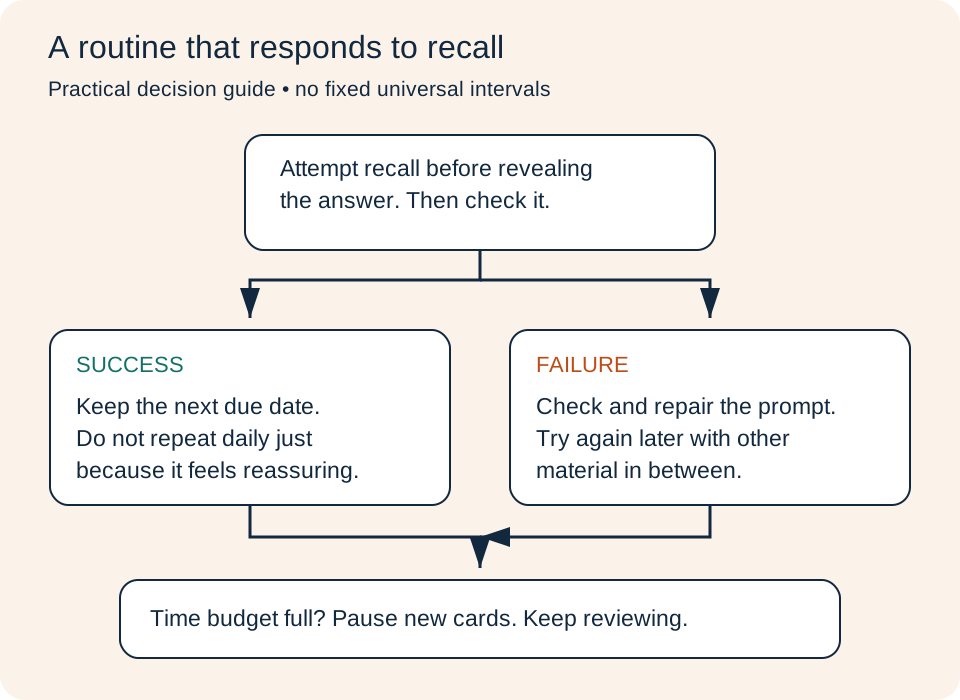
Figure 1. An editorial decision guide, not an algorithm trace. Text equivalent: attempt recall before revealing the answer. If correct, follow the next due date. If incorrect, check the answer and repair an unclear prompt before a later retry. In either branch, stop adding new cards when due reviews fill your time budget.
Checking the answer matters. Pashler and colleagues' word-learning experiments (2005) found particular benefit from correct-answer feedback after failed responses. Their laboratory task does not establish a universal delay for feedback, but it gives a sound reason to include the actual correction on the back rather than only a “wrong” marker.
An effortful attempt can still be useful. Difficulty becomes unproductive when the prompt requires knowledge you have never learned, accepts several answers without saying so, or asks for a long list you cannot grade consistently. For this routine, “desirable difficulty” means attempting a clear, learned task before receiving feedback. It does not mean deliberately making the wording obscure or waiting until you fail every time.
Keep a small repair list. If a card repeatedly fails, identify one cause: an unfamiliar concept, a confusing cue, an incorrect answer, or a task beyond your current level. Fix that cause before adding more repetitions. For the broader evidence and its limitations, see the spaced repetition research guide.
Build cards that test the skill you need
A vocabulary entry and a flashcard are different objects. An entry may contain spelling, pronunciation, translations, grammar and several examples. A card needs a question you can answer and grade. Keep the extra information on the back as feedback; split it into separate prompts only when those additional skills matter.
| Purpose | Example front | Example back / grading rule |
|---|---|---|
| Reading recognition | In “La cuenta, por favor,” what does la cuenta refer to? | The bill/check at a restaurant. Accept either English term. |
| Written production | At a restaurant, complete “La ___, por favor” to request the bill. | cuenta. This prompt tests the noun, not the whole sentence. |
| Gender and noun together | Write the Spanish singular noun with definite article for a restaurant bill. | la cuenta. Include the article because that is the stated target. |
| Listening recognition | Listen to a recording of “La cuenta, por favor.” What is being requested? | The bill/check. Put the transcript on the back. |
These are four alternative designs around one item, not instructions to make four cards for every word. The downloadable template includes text examples and a place to record the source of an audio clip. It contains no audio file and does not claim to be a directly importable Memor More deck.
For listening practice, use a clip you have permission to use and check its pronunciation with a reliable speaker or reference. Hide the transcript during the attempt; otherwise you are partly testing reading. For production, avoid placing a recording of the target answer on the front. Play it after the attempt as feedback. Images can supply a meaningful cue when that suits the task, but decoration is not a substitute for an answerable question.
If you start from class notes, the notes-to-flashcards walkthrough shows how to review generated output. The AI flashcard generator guide explains verified inputs and limits. Check translations, context and grading rules yourself before putting generated vocabulary into the daily queue.
Choose a learning mode for the task
Memor More offers several ways to work with a deck alongside scheduled review. Its Quiz mode is a one-minute speed challenge: identify as many words as you can before time runs out. A separate typing mode asks you to enter the full term. Generated Practice Sets give you exercises built from a deck, so you can approach its material through different prompts. These capabilities were confirmed by the product owner on 13 September 2026.
| Your task today | A mode to try | What to pay attention to |
|---|---|---|
| A quick vocabulary recognition challenge | One-minute Quiz | Which terms slow you down or get confused |
| Producing a complete written answer | Full-term typing | Whether you can write the term without seeing it first |
| Working with familiar terms from another perspective | Generated practice exercises | What the new prompt asks, and whether its answer is clear |
| Returning to material over time | Scheduled review | The due queue and an honest grade for the attempt |
For the beginner scenario above, try a one-minute challenge after the scheduled session if time remains. For the intermediate learner, use typing when the task is written production, or try a Practice Set to encounter different questions about the same deck. These are practical suggestions, not tested learning outcomes. A fast quiz score and accurate typing answer different questions; neither alone establishes that you can use a term in conversation.
Read the practice exercises guide for the deck-to-exercise workflow. Memor More also has a community where users share decks. Explore the public library, inspect a shared deck’s prompts and answers, and contribute a deck when you have useful material to share. For a class or study group, the shared-deck guide explains the collaboration workflow.
Adjust workload using your own review time
Count prompts, not just words. Five words with a recognition and a production card become ten cards. Those cards can each return for review. A small daily intake can therefore create more work than the original word count suggests.
Here is budget arithmetic, not a learning prediction: if you spend about fifteen seconds attempting and checking each of forty cards, the reviews take ten minutes. That leaves no room within a ten-minute session for creating cards or investigating confusing answers. Measure a few of your own sessions; do not borrow this example's speed as a target.
When due work repeatedly exceeds your budget, pause new cards first. Review manageable portions and repair time-consuming prompts. After a missed weekend, resume the queue rather than resetting every successful card to “new.” If your circumstances have changed, reduce the scope of the deck. A routine that depends on free time you no longer have needs a smaller intake.
Write down weekly review time, repeated failures and whether you can use the target words outside the deck. Use those observations to change one thing at a time. If you simultaneously double your intake, change every prompt and switch algorithms, you will have little basis for deciding which change helped.
FSRS in the next Memor More build
Availability update: 13 September 2026. FSRS is now available in Memor More, as confirmed by the product owner. The routines above work with adaptive scheduling: review the due queue, grade the attempt and keep new-card intake manageable. You do not need to reproduce a fixed sequence of intervals.
Previously checked SM-2 behavior: the iOS source inspected on 13 September 2026, configured as 1.3.5 (5) used SM-2 by default, with Simple Exponential and Leitner alternatives. This is source verification, not a newly installed-build test. A separate 9 September app test of 1.3.3 (5) also confirmed the SM-2 default and alternatives.
These details are specific to that earlier SM-2 build, not the current FSRS release. In the inspected implementation, a new card rated Good gets a nominal one-day interval; its second consecutive successful review rated Good gets six days. Successful due dates include small random variation. Again assigns a ten-minute due interval and resets the successful-review count. A session can also retry a failed card after intervening cards, so the in-session retry is not a ten-minute countdown.
Use the due queue and grade the actual attempt. Do not translate the examples above into a promise that your app will display their exact weekdays. The FSRS vs SM-2 guide explains the upcoming release, the previously checked implementation and why the algorithm name alone does not determine every due date.
Start with one useful item
Copy the template, choose one word or phrase you actually expect to use, and make one clear prompt. Check its answer and source. Add it to your next short review session, then use the success/failure branches above to decide what to do next. Expand only when the existing routine fits your week.
Written by Anatolii Valeev for Memor More, the product discussed here. Examples and time budgets are editorial illustrations, not participant data, an individualized prescription or a retention guarantee. Research and product-source references were checked on 13 September 2026.
Written by
Founder & developer of Memor More. I build iOS and Mac apps and write about the science of memory and learning. @Jerelii on X