
FSRS vs SM-2: what changes your next review?
Compare FSRS and SM-2 with a worked example, learn how Memor More uses FSRS, and see how the previously checked SM-2 review behavior worked.
SM-2 adjusts review intervals using a card's review grade and easiness factor. FSRS models memory difficulty, stability and recall probability, using elapsed time and review history to inform scheduling. Memor More includes FSRS. The practical choice also depends on an app's controls and the quality of your review data.
This guide separates the original algorithms, a conceptual example, Memor More's current FSRS availability, and its previously checked SM-2 implementation. If you want a daily routine first, use the vocabulary schedule and card template. You do not need to understand the equations to start practicing clear prompts and honest recall.
Start by distinguishing three things
An algorithm specifies how information about a review changes a card's next interval. An implementation adds choices such as rounding, short learning steps, interval caps and the treatment of overdue cards. The interface decides which of those choices the learner can see or change.
That distinction matters when two apps use the same algorithm name but display different dates. One may add a short retry after a lapse. Another may round to calendar days or spread reviews slightly to avoid identical due dates. A named algorithm is useful information, but it is not a complete product specification.
Likewise, “SM-2” can refer to the historical rule or to a modified descendant. “FSRS” identifies a versioned open-source project used by different products. Do not assume Anki's settings appear in every app using FSRS, or that a description of original SM-2 reproduces every app labeled SM-2.
What original SM-2 does
Piotr Wozniak's original SM-2 description gives each item an easiness factor, initially 2.5, and uses response grades from zero to five. Successful repetitions begin with intervals of one and six days. Later intervals grow by multiplying the previous interval by the easiness factor. Grades adjust that factor; a failed response restarts the repetition sequence.
The core idea is a compact heuristic: use the record of success and difficulty to adjust future gaps for each item. It does not fit a personal probability-of-recall curve or expose a desired-retention target in the original specification. The historical source is an algorithm description and account of its development, not independent proof that a modern app guarantees the same outcomes.
A learner can use such a system without managing a separate calendar. What requires care is treating its intervals as observations about memory. They are scheduling decisions. A card appearing in six days does not establish that you will remember it on day five and forget it on day seven.
What FSRS models
FSRS stands for Free Spaced Repetition Scheduler. The maintainers' algorithm documentation, checked on 13 September 2026, describes FSRS-6 with 21 parameters. It tracks difficulty and stability, and estimates retrievability from stability and elapsed time.
Difficulty describes how hard it is for a card's stability to grow. Stability is expressed as the interval associated with 90% modeled recall. Retrievability is the estimated probability of recall at a particular time. These are model quantities, not measurements of a brain or assessments of intelligence.
The official introduction to FSRS explains how parameters can be fitted to review history, with defaults available when personal history is insufficient. Desired retention provides a scheduling target: higher targets generally require more reviews. A target of 90% is not a promise that you will recall exactly nine of your next ten cards.
Anki exposes desired retention and parameter optimization in its FSRS deck options. Those controls describe Anki's implementation; we have not independently re-checked Memor More's exact FSRS version, controls or defaults. The same manual separately covers learning and relearning choices. Always check your app and algorithm version before following a settings tutorial.
A conceptual example with explicit assumptions
Consider two hypothetical copies of a vocabulary card asking for the Spanish noun and article for a restaurant bill. Immediately after their last review, both copies have identical scheduling state. The learner returns to one copy after ten days and the other after thirty days. In both cases they produce la cuenta correctly and give the same successful grade.
Assumptions: this is a thought experiment, not two real learners or a measured trial. Card content, prior state and rating are held constant; only elapsed time changes. There is no intervening practice, hint, audio exposure or extra review. We compare the inputs used by the historical SM-2 rule and an FSRS memory model. We do not execute FSRS, fit parameters, simulate retention or claim a particular next interval.
| Input or decision | Card A | Card B |
|---|---|---|
| Prompt and prior scheduling state | Identical | Identical |
| Elapsed time since last review | 10 days | 30 days |
| Recall result and grade | Successful, same grade | Successful, same grade |
| Historical SM-2 recurrence | Same prior interval/easiness and grade give the same nominal next gap | Same nominal next gap, scheduled from the later review date |
| FSRS interpretation | Recall is evaluated after the shorter gap | Recall is evaluated after the longer gap; the model has different evidence about forgetting |
The model can use elapsed time to distinguish these observations. That is the conceptual difference illustrated here; the table does not prove a workload saving or predict which learner will remember more. Actual FSRS output requires a pinned implementation, its parameters and complete state. Modified SM-2 implementations can also include overdue handling, so this table must not be read as a test of Anki's legacy scheduler.
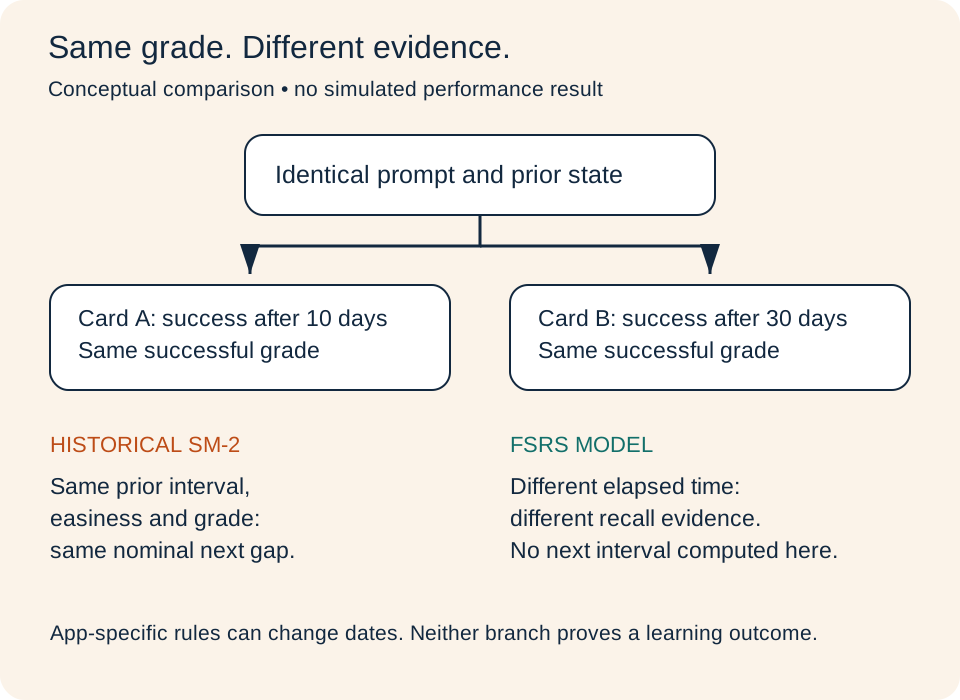
Figure 1. Original conceptual comparison. Text equivalent: identical initial card states branch into a successful review after ten days and after thirty days. Historical SM-2's interval recurrence receives the same prior interval, easiness and grade. FSRS evaluates different elapsed times through its recall model. No fitted parameters, computed FSRS dates or retention outcomes are supplied.
Now change the second branch to a failed recall. Both approaches have a way to respond to failure, but you should not carry the successful-review conclusion into that case. A lapse changes the information available. The app may also insert short retries independently of its long-term scheduling rule. Inspect that behavior rather than assuming that every missed card starts its entire learning history from scratch.
FSRS in Memor More
Availability update: 13 September 2026. Memor More’s product owner confirmed that FSRS is now in place. The comparison above explains the algorithm used by that release. Its exact FSRS version, default settings, user controls and treatment of existing review history have not yet been independently checked, so this guide does not infer those details.
The SM-2 behavior below describes the build we previously inspected. It is a version-specific reference for an earlier release, not a specification for the current FSRS implementation. In particular, its first-review intervals, lapse handling and maintenance limits should not be assumed to carry over to FSRS.
Previously checked SM-2 behavior
Verification date: 13 September 2026. We inspected the iOS main-branch source at revision cafad4d08d446, configured as version 1.3.5 (5), and executed its scheduler functions with controlled card fixtures. This verifies code behavior, not a newly installed app or its App Store release status.
The earlier Memor More and Anki comparison records a separate test of installed 1.3.3 (5) in an iOS 18.6 test environment on 9 September. That test observed the SM-2 default and alternative algorithms. It did not exercise every source behavior described here. Browser behavior and other released versions are outside this scheduler check.
The inspected SM-2 build had these characteristics:
| Item | Memor More native source behavior |
|---|---|
| Default for a new deck | SM-2 |
| Alternative algorithms | Simple Exponential and Leitner |
| Learner controls | Per-deck algorithm choice; Again, Hard, Good and Easy after revealing the answer |
| Starting easiness | 2.5, with updates constrained to 1.3–3.0 |
| First successful review | Hard: 0.5 days; Good: 1 day; Easy: 4 days, before due-date variation |
| Second successful review | Hard: 3 days; Good: 6 days; Easy: 7.8 days, before due-date variation |
| Later successful reviews | Hard grows the previous interval by 1.2; Good uses updated easiness; Easy also applies a 1.3 bonus |
| Failed recall | Again sets a nominal 10-minute due interval, resets successful repetitions and mastery, and preserves easiness |
These numeric values come from the product source, not the original SM-2 article. Repeated Good ratings on a fresh controlled card produced nominal gaps of 1, 6, 15 and 37.5 days in the check. These are intervals after reviews, not calendar-day labels measured from the first study session. Successful due dates receive ±5% random variation, so a displayed date need not match that sequence exactly.
The fifth successful repetition sets an app “mastery” flag. Mastered cards continue on a nominal maintenance interval between 30 and 180 days, before due-date variation. That label is software state, not evidence of fluency or permanent learning. Again removes mastery on the normal scheduled-review path and the next successful review restarts the initial interval sequence.
There is a separate session behavior: a failed card may be inserted after up to three intervening cards, with at most two reinserts and only when another card remains. This is not a ten-minute timer. The session order and the stored due date are different mechanisms. Free Study does not update the spaced-repetition schedule in the inspected source.
For a trial, use a small set and inspect what the interface shows after each grade. Do not switch an established deck just to make its numbers resemble a screenshot from another app. The iPhone alternative comparison helps you weigh scheduling controls against the rest of the product workflow.
Scheduling is one part of the learning experience
Memor More also offers a one-minute Quiz challenge, where you identify as many words as possible, and a typing mode that requires the full term. Practice Sets contain generated exercises built from your deck, offering another way to work with the same material. The app’s community lets users share decks. These capabilities were confirmed by the product owner on 13 September 2026.
The scheduler comparison concerns when reviews are due. A learning mode concerns what you do with the material: recognise a term under time pressure, type it, or answer an exercise from a different perspective. Choose the task that matches what you want to practise. There is no need to reduce that choice to the scheduler’s name.
The practice exercises guide describes the deck-to-exercise workflow. When comparing your own results across apps or builds, record this additional practice too: a week with several quizzes and Practice Sets differs from a week of scheduled reviews alone. Do not attribute the entire difference to FSRS or SM-2, or treat a quiz score as a measurement of long-term retention.
When algorithm choice deserves attention
Algorithm choice is relevant when you have a sustained review habit and a specific problem: the workload exceeds your budget, overdue reviews are common, or you want to control a modeled retention target. You can then evaluate whether a different app exposes a useful control and whether it has sufficient history to use it sensibly.
Start by writing down the problem in observable terms. “My due queue takes thirty minutes and I have fifteen” is actionable. “The algorithm feels old” does not tell you which behavior to change. Record daily review time, new-card intake and how often you fail before deciding what to adjust.
For a personal trial, keep the material and grading standard stable where practical. Record the app version and settings. Allow time for due work to develop, rather than comparing only the first session with new cards. Changing both the scheduler and the entire deck gives you little basis for attributing a difference to either one. Even a careful personal comparison is not a randomized study and may reflect practice you did outside the app.
Be especially careful with a percentage advertised as “fewer reviews.” Determine whether it comes from a simulation, prediction benchmark or actual learning study. A model can predict recorded grades well without demonstrating the same savings for your cards, habits or language goal. This guide does not report a head-to-head Memor More/FSRS learning experiment because none was performed.
What to fix before changing algorithms
An ambiguous prompt is a poor input for either approach. If the front asks “bank” without context, a translation for a financial institution and a river edge might both be defensible. A failed grade then mixes vocabulary knowledge with a wording problem. Add the intended sense or a short sentence before asking the scheduler to interpret the result.
Define success before revealing the answer. For a prompt explicitly testing a noun and its article, omitting the article is not full success. For a meaning-recognition prompt, accept the equivalent wording you decided was valid. Avoid upgrading a failed attempt after the answer looks familiar. The program receives your grade; it cannot reconstruct an unrecorded hint or your original hesitation.
Card writing and scheduling solve different parts of the task. The notes-to-flashcards guide shows a worked editing process, and the AI generator page explains the supported workflow. Review generated prompts for ambiguity before accumulating a long history of inconsistent grades.
Review consistency also deserves attention. A scheduler cannot run a retrieval attempt for you while the app is closed. If due work repeatedly prevents you from returning, reduce new-card intake and set a realistic session budget. Do not infer from a difficult week that the learning method has failed. The research guide separates the evidence for spacing from product-specific claims.
Choose around the task you will repeat
FSRS is available in Memor More. Before changing a long-running routine, check its current scheduling options and guidance for existing decks. If a particular control such as desired retention or parameter fitting matters to you, confirm how the installed release exposes it. Start small and judge the routine by whether you can maintain it and use the material beyond the screen.
You can inspect the Spanish A2 sample deck or browse public decks before building a large collection. Pick a few prompts whose answers you understand, state your grading rule and complete a review. That gives you a concrete task against which to assess the app's scheduling behavior.
Written by Anatolii Valeev for Memor More. We have a commercial interest in the product described. Algorithm documentation and product source were checked on 13 September 2026; the conceptual example is original editorial analysis, not a clinical claim, learner dataset or guaranteed retention outcome.
Written by
Founder & developer of Memor More. I build iOS and Mac apps and write about the science of memory and learning. @Jerelii on X