
Teacher maintains one deck
Build a reviewed unit around explicit objectives and small retrieval prompts, then choose Link only or Public. Collaborative editing is not currently available.
For teachers · prepared workflow demo
Memor More lets a teacher maintain one source deck, share it with students, and correct it as the class progresses. Students can import and study in the browser on any platform, while the flagship iPhone, iPad, and Mac app provides the complete feature set and shared-update workflow.
We developed and prepared the short demo below to show the behavior and core usage principles with a structured 12-card biology unit. The workflow and teaching approach have been reviewed and verified by practicing language teachers.
Open the browser app on any platform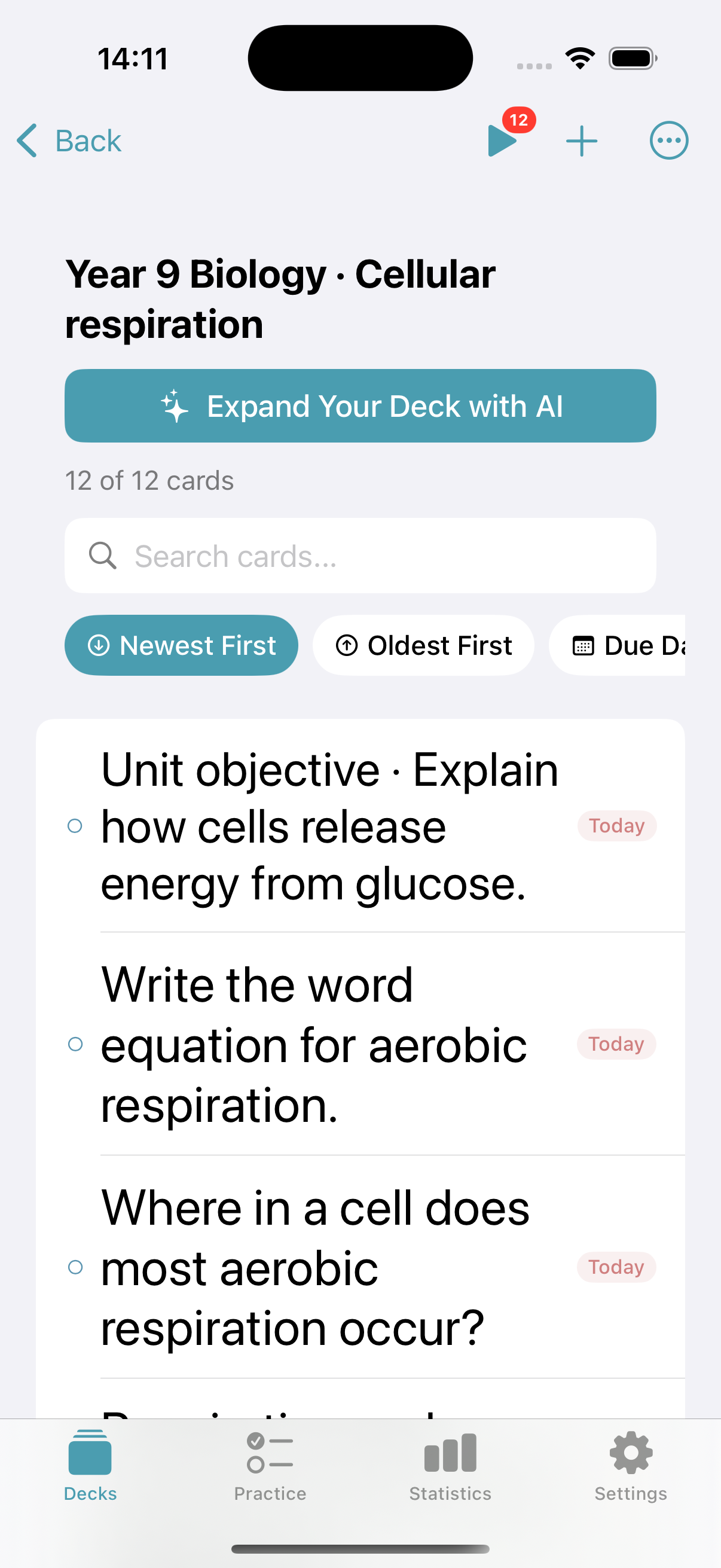
Complete workflowCreate, share, import, study, correct, and maintain
Study from any platformBrowser access, plus the complete app on iPhone, iPad, and Mac
Teacher verifiedCore usage principles reviewed by practicing language teachers
The useful distinction is between shared content and personal practice. The teacher controls the source cards. Students import the content, but their review history and next-due dates are their own. In the full Apple app, the deck checks for source revisions as it refreshes.
Build a reviewed unit around explicit objectives and small retrieval prompts, then choose Link only or Public. Collaborative editing is not currently available.
Use a share link for the full app, or provide a supported deck import or public-deck copy for browser learners. Treat unlisted links as access information.
Students can import and study in a modern browser on any platform, or use the full app on iPhone, iPad, and Mac.
In the full Apple app, an edited card or deletion reaches an imported deck when it refreshes, while the student keeps a personal review schedule.
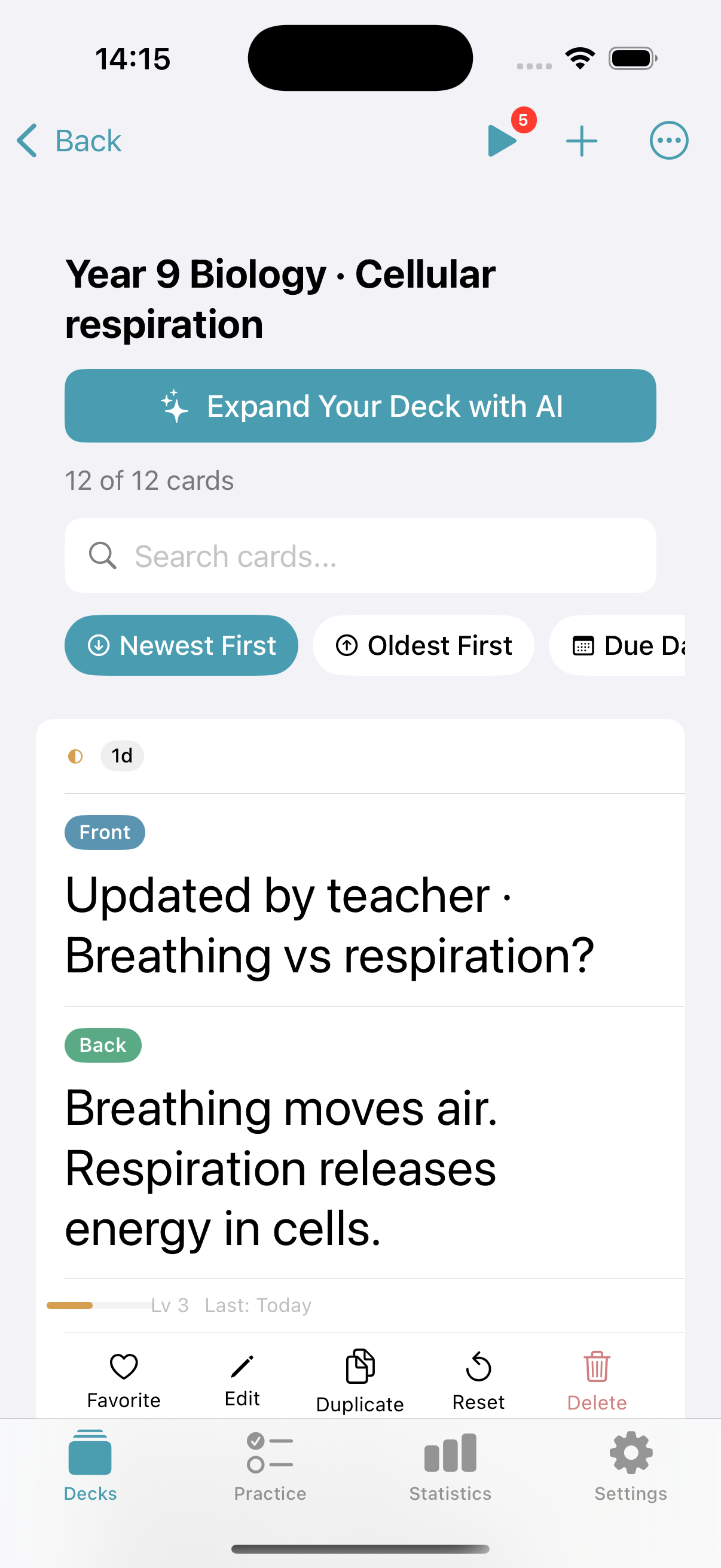
Correction principle: after a student has begun reviewing, the teacher can correct the source content. In the full app, the revised text reaches the imported copy on refresh while the learner’s existing due and last-reviewed values remain in place.
The app is most defensible as a teacher-maintained retrieval layer around instruction—not as the lesson, an assessment system, or a learning-management platform. These examples separate what the teacher prepares, what the student does, and what should be checked before calling the routine effective.
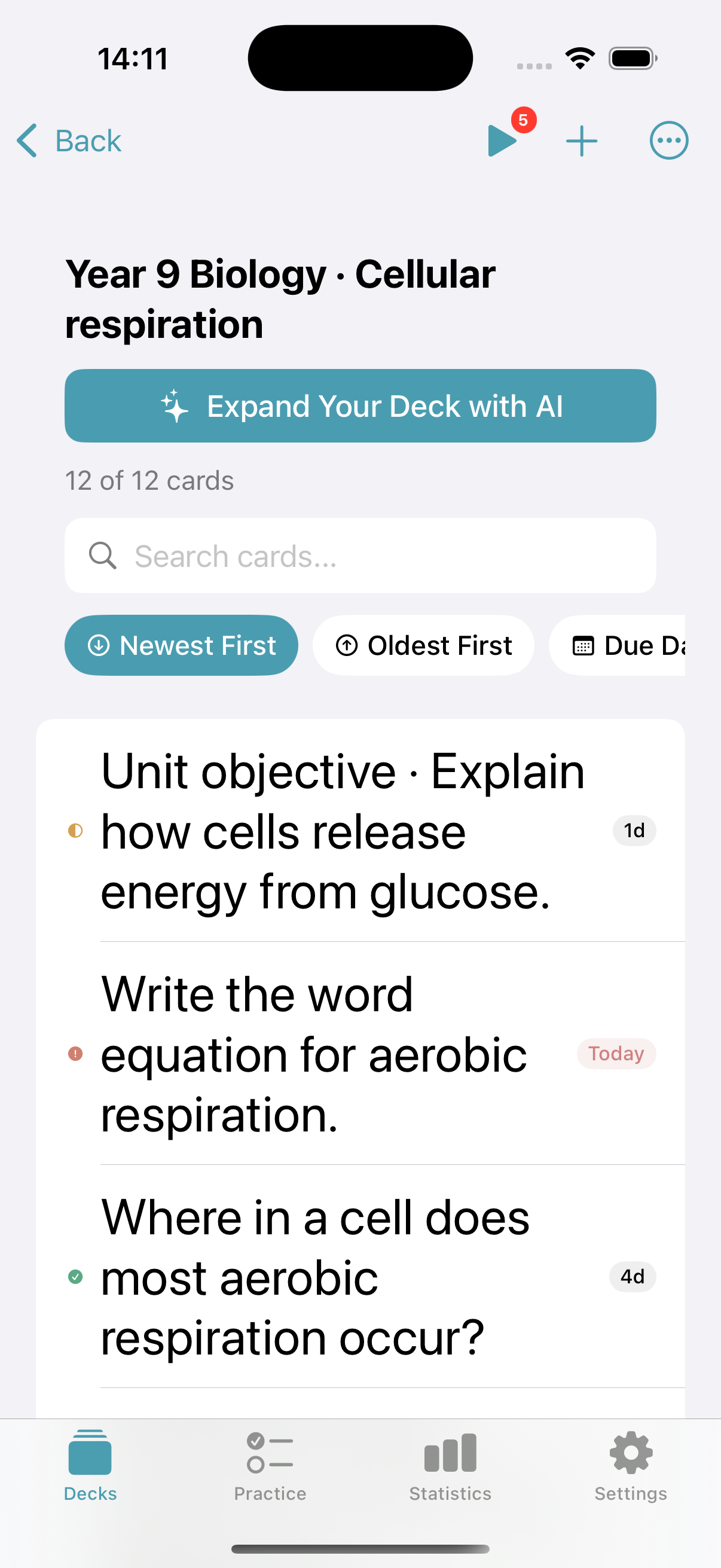
What the screenshots can demonstrate: coherent teacher-prepared material, access choices, learner-specific due states, and the corrected-card UI. What they cannot demonstrate: adoption, retention, attainment, time saved, or any causal learning benefit.
We developed this short demo with twelve connected Year 9 biology cards covering an objective, core facts, a word equation, applications, misconceptions, and comparison. The structured material makes the sequence easy to evaluate, and no teacher, student, school, or classroom data appears.
This demo explains the current product behavior and the boundaries that matter in a classroom. Store requirements and institutional policies can change, so verify the live App Store listing and your institution’s rules before rollout.
| Decision point | Current answer |
|---|---|
| Browser and full app | Students can create, import, edit, and study browser-local decks on any platform with a modern browser. The flagship iPhone, iPad, and Mac app provides the complete feature set, including shared-deck updates, iCloud sync, AI generation, and offline use. |
| Student account | The browser app works without an Apple sign-in and stores decks in that browser. The native shared-link workflow creates an anonymous device account behind the scenes for sharing services. |
| Free / Premium sharing | Current app and backend rules define one active shared deck on Free and no numeric shared-deck cap on Premium. |
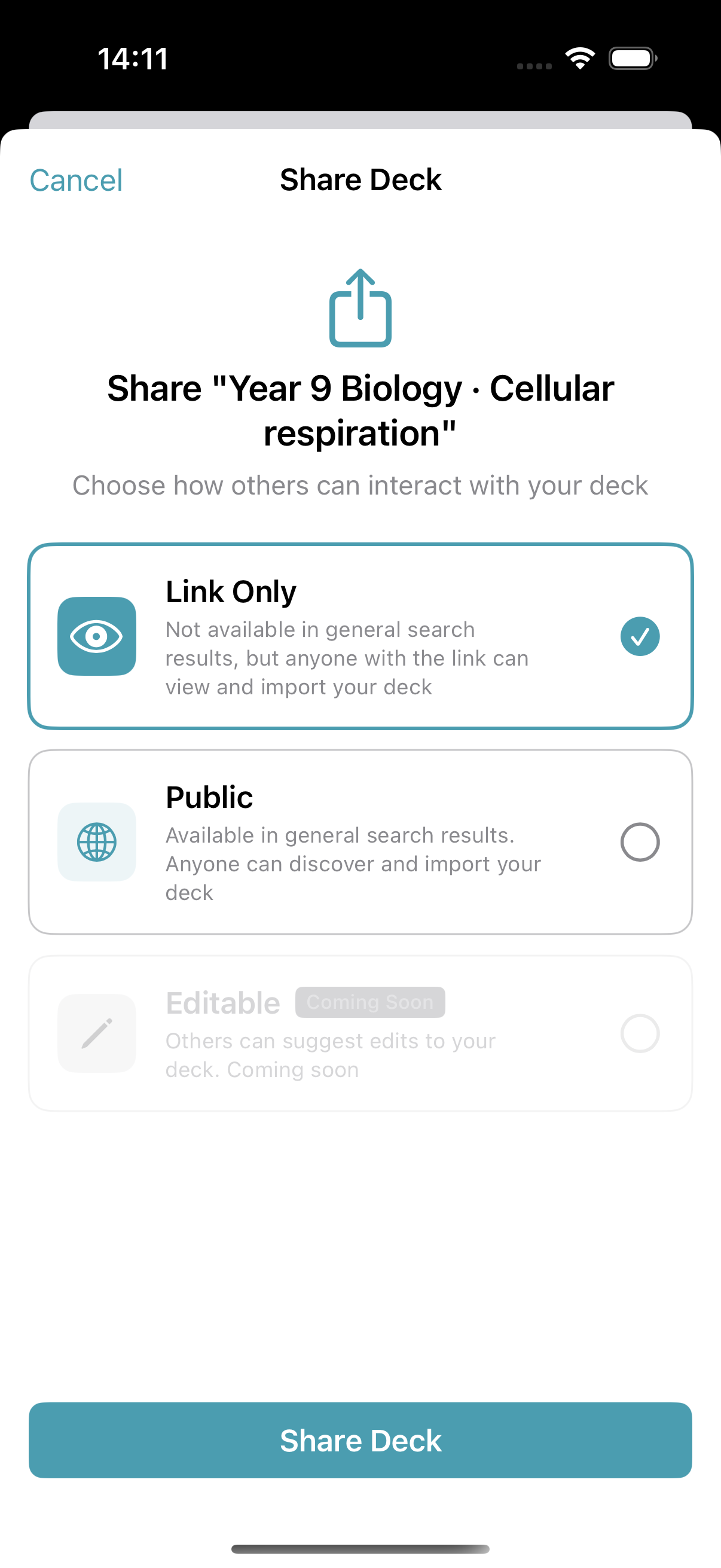
| Permissions | The teacher owns and edits the source. Link only and Public were available; Editable was marked Coming soon. There is no roster or student-progress dashboard. |
| Update timing | In the full Apple app, an imported shared deck checks for changes when it refreshes. This is not simultaneous collaborative editing or a guaranteed real-time push. |
| Review schedule | A source correction can update card content in the full app without replacing the learner’s existing due date and last-reviewed value. |
| Deletion and unsharing | In the full-app share workflow, deleting a source card removes it from the imported deck after refresh. Unsharing invalidates the link, while an existing importer retains the local copy. |
| Data path | Sharing uploads the deck content and its media to Memor More’s service. Student review history stays with the student and was not part of the shared-deck update. |
There is no teacher view of a student’s scores, due cards or study activity. Memor More is a content-distribution and individual-practice tool, not a classroom-management system or LMS.
Start with one group, one short deck and material you are permitted to upload. That exposes device, link-distribution and card-quality problems before the workflow becomes part of a course.
Read the full workflow guideChoose browser access for students on any modern platform, or the full Apple app when the complete feature set and shared updates are needed. For younger learners, follow school and guardian requirements.
Use one fact or prompt per card. Check answers, reading level, copyright and accessibility before publishing. Keep a source record for curriculum-specific claims.
For the full app, choose Link only and send it through a trusted channel. For browser learners, provide a supported deck import or public-deck copy and explain how later revisions will be supplied.
Confirm the deck appears, complete one study action, then check that every learner understands their schedule is personal.
Edit a harmless card, ask students using the full app to refresh, and verify both the content change and their existing progress before relying on weekly updates.
Tell students what happens if you revoke the link or delete a card. Retain an approved source copy and decide who owns maintenance after the course.
These public decks are live examples and starting points, not a substitute for reviewing the exact material you assign. Practicing language teachers have verified the workflow and core usage principles; each deck should still be checked against your curriculum, learner level, and local terminology.
Use a public deck as a draft: inspect every card, adapt it to your learners, and share only the version you are prepared to maintain.
Everyday vocabulary and short phrases for English-speaking learners.
Preview cardsDefinitions and formulas suitable for a teacher’s card-by-card review.
Preview cardsA Singapore primary-science set that should be checked against the school’s current syllabus and wording.
Preview cardsLink only removes public discovery; it does not identify or approve individual recipients. Anyone with the URL can open it while sharing remains active. Do not put names, grades, health details or other personal data in cards.
Private local decks can stay on the device or use private iCloud sync, but publishing a share uploads that deck and media to Memor More. Review the privacy policy and institutional requirements first.
Stopping a share makes the old link unavailable, but the confirmation warns that people who already imported it keep their copy. Plan content ownership and removal expectations accordingly.
We developed and prepared this short demo to show a coherent source deck, student access, personal review schedules, and a later correction. The material is structured like a real teaching unit rather than filled with placeholders.
The workflow and core usage principles have been reviewed and verified by practicing language teachers. That supports its practical fit for language teaching, but it is not a quantified learning-outcome claim or a guarantee for every school environment.
Create ten reviewed cards and share them with a small group. Students can study from any platform in the browser; use the flagship Apple app when you need the complete feature set, including the shared-update workflow.